
Blood stains on a sofa: how to remove them without ruining the fabric
A blood stain is treated with cold water, never hot. A step-by-step method for fresh and dried stains, and the mistakes that set them for good.
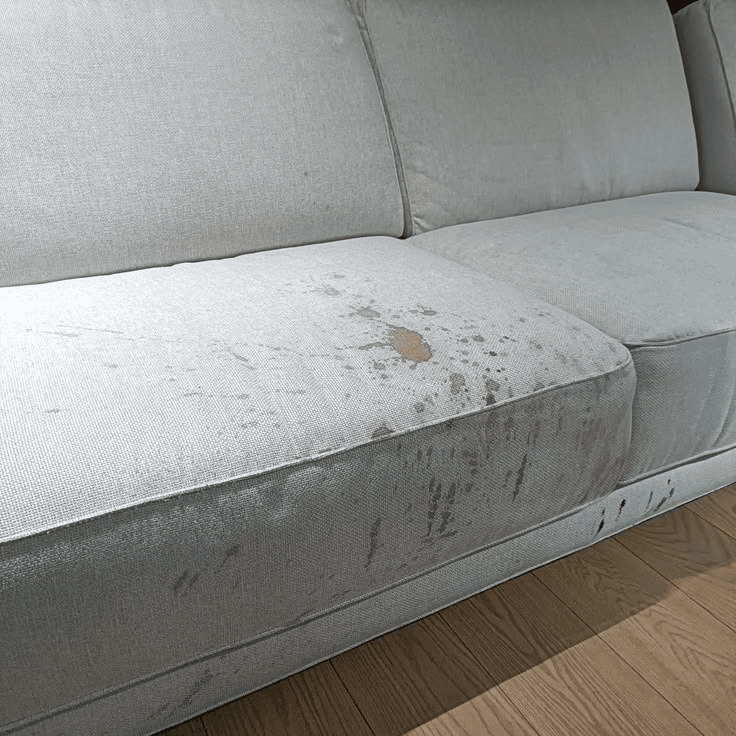
A blood stain on a sofa is rarely something you discover at a convenient moment. The good news: treated properly, it comes out in the large majority of cases. The bad news: what most people reach for first — hot water and a cloth they rub hard — is precisely what sets it.
Here is what actually happens inside the fibre, and how to proceed depending on whether the stain is fresh or already dry.
Why blood is not an ordinary stain
Blood is not a conventional coloured stain. It is protein-based, rich in haemoglobin. Two properties explain everything else.
First, it coagulates. The process starts on contact with air, within minutes. As it coagulates, the proteins form a network that grips the fibres of the textile mechanically. The more time passes, the denser that network becomes and the more firmly it holds to the fabric.
Second, heat accelerates and locks in that process. Above roughly 40°C the proteins denature: their structure changes irreversibly and they bond to the fibre. It is exactly what happens to an egg white going from liquid to solid as it cooks — and you cannot turn a cooked egg back into a raw one.
This is why hot water must be avoided on a blood stain. It does not dilute the stain, it cooks it into the fabric. A stain treated with heat often stays visible afterwards, even once it has been treated correctly.
Cold water, by contrast, keeps the proteins soluble and allows them to be drawn out gradually.
Fresh stain: the step-by-step method
The principle: absorb, dilute cold, absorb again. Repeat the cycle rather than attacking hard in one go.
-
Absorb the excess immediately. Kitchen roll or a clean white cloth, laid flat, without pressing hard. The aim is to lift the liquid that has not yet soaked in. Move to a clean part of the cloth with each pass, otherwise you put back what you have just taken out.
-
Use a white cloth. A coloured cloth can release its own dye onto damp fabric. It is a common incident, and an avoidable one.
-
Dampen with cold water. Lightly wet a clean cloth — wrung out, not dripping — and blot the stain from the outside in. Working in that direction keeps you from spreading the edge.
-
Blot, do not rub. Blotting transfers the stain to the cloth. Rubbing spreads it and pushes the particles down between the fibres.
-
Repeat. Three or four short cycles give a far better result than a single heavy pass.
-
If the stain holds on, add a mild agent. A drop of neutral soap or washing-up liquid in half a glass of cold water, applied with the cloth. Then rinse by blotting with clean cold water, otherwise the soap residue will hold dust and form a greyish patch.
-
Dry quickly. Blot with a dry cloth, then let it air-dry with the room ventilated. A fan pointed at the area speeds things up considerably. Avoid a hairdryer on a hot setting, for the reason explained above.
A little 3% hydrogen peroxide is effective on blood, by oxidation. But it lightens many dyed textiles. If you use it, test on a hidden area first — under a seat cushion, or the back of the backrest — and wait until it is completely dry before judging the result.
Dried stain: what changes
A stain that is several days old is not a lost cause, but it needs an extra step: rehydration.
Start by gently scraping off the surface deposit, using the back of a spoon or a soft-bristled brush. Vacuum up the residue. That removes the part which is no longer bonded to the fabric.
Then re-wet with cold water and leave it for ten to fifteen minutes, keeping the area slightly damp without soaking it. The aim is to soften the protein network, not to flood the foam.
This is where an enzyme-based stain remover makes the difference. Protease enzymes cut the proteins into soluble fragments, something water alone cannot do on a stain that has settled. You will find them in textile stain removers sold for "organic stains". Respect the stated dwell time: enzymes need time, not mechanical force.
Finish with a cold-water rinse by blotting, then dry quickly.
An old stain often lightens in stages, over two or three treatments spaced apart. If it stops moving altogether after two proper attempts, pushing further will damage the fabric before it lifts the stain.
The mistakes that genuinely make things worse
These four are the most common, and their consequences are concrete.
Hot water. It coagulates the proteins and fixes the stain in the fibre. This is the most expensive mistake, because it cannot be undone.
Rubbing. It disrupts the structure of the textile. On a pile fabric (velvet, chenille) it crushes the material and leaves a shiny mark that stays visible once the stain is gone. On a tight weave it causes pilling. And in every case it spreads the stain beyond its original perimeter.
Harsh stain removers. Bleach simply strips the colour out of dyed textiles. Ammonia is effective on blood but attacks protein fibres — wool, silk — which are chemically close to it: it stiffens and dulls them. It must never be mixed with a chlorine-based product, as the reaction releases toxic fumes.
Over-wetting. This is the silent mistake. A sofa is not just a fabric: it is a block of foam. Pouring on water or product in quantity drives the moisture down into the padding, where it evaporates only very slowly. Two things follow: rings on the surface, as the water travels back towards the edges while drying and deposits residues and minerals there — something pronounced in the Île-de-France, where the tap water is hard — and, if the moisture sits for several days, a musty smell caused by microbial growth in the foam. That second problem is far harder to put right than the original stain.
The rule: as little liquid as possible, and the fastest drying you can manage.
Adapting to the fabric
Check the care label under the seat first. A W code allows water-based cleaning, S requires a solvent, WS tolerates both, and X means vacuuming only and points you to a professional.
Cotton and linen. The most tolerant of water. In exchange, their visible weave shows rings easily: treat a wide area rather than a precise spot, so that the edge of the damp zone does not sit on the outline of the stain.
Velvet. The vulnerable part is the pile, not the stain. No rubbing at all, very little moisture, light blotting, then brush in the direction of the pile once dry.
Microfibre. Often coded S, so treat it with a solvent rather than water — water leaves sharp circular marks on it. Check the label before anything else.
Wool and wool blends. A protein fibre: no ammonia, no alkaline product, no heat. Cold water and neutral pH only.
Leather. Blood sits on the surface instead of soaking in, which works in your favour if you act quickly. A slightly damp cloth, mild soap, then dry immediately and apply a leather conditioner. No hydrogen peroxide, no ammonia, no alcohol: they dry out and discolour leather.
When to hand it over to a professional
There are situations where persisting costs more than the stain itself:
- The stain is old and has not moved after two proper treatments.
- The fabric is delicate or unidentified: silk, viscose, silk velvet, or a label coded X.
- The affected area is large, or several stains overlap — the risk of rings becomes hard to control by hand.
- The sofa has real value, sentimental or financial, and you would rather not spend your one attempt on it.
- A smell lingers after drying, a sign that moisture has gone down into the foam.
Professional treatment is built on hot-water extraction: the solution is injected into the textile under pressure, then immediately vacuumed back out along with the soiling it has released. The value lies precisely in the extraction — that is what prevents the padding from being over-wetted and allows drying within a few hours, where treating it by hand lets the moisture settle in.
We work at your home across Paris, the Hauts-de-Seine and the Val-d'Oise, bringing the equipment with us. You will find how a job unfolds and the areas we cover on our sofa cleaning at home page, and what each item costs on our pricing page.
Frequently asked questions
Does hot water remove blood better?
How long do I have before the stain sets?
Can I use hydrogen peroxide on a sofa?
Why does a ring appear once the fabric dries?
Will blood come out of a velvet sofa?
To read more about how we work, see our page on sofa cleaning at your home.